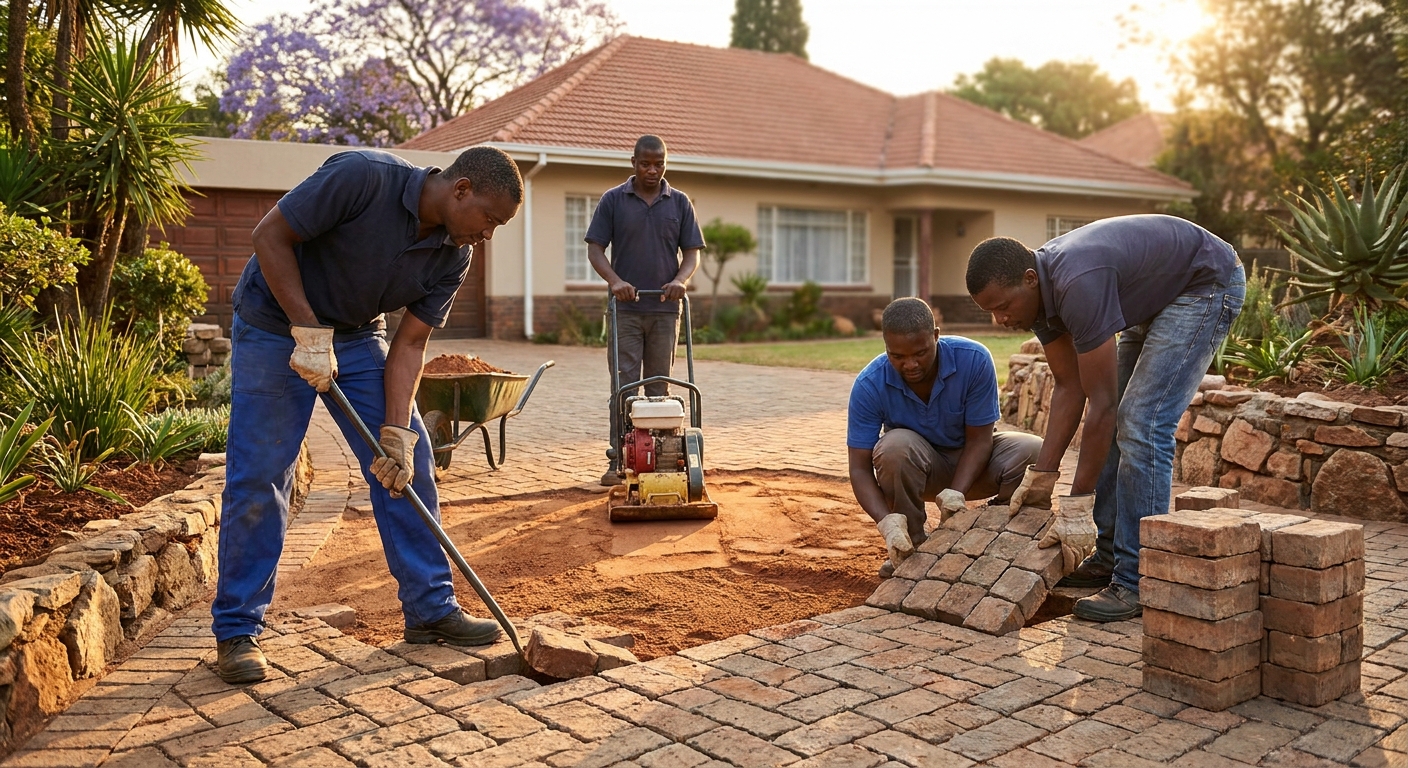

Uneven driveway paving in Johannesburg usually results from subgrade failure or expansive clay soil movement. To resolve this issue, we must lift the affected pavers, excavate the failing base, and re-compact the foundation using SABS-compliant G5 sub-base material as outlined in SABS 1200 engineering standards. Replacing the pavers without addressing the underlying drainage or compaction issues will lead to recurring subsidence; our technical team restores structural integrity to prevent the water pooling that accelerates driveway degradation.
Why Does the Sub-Base Fail Under Driveway Paving?
Subgrade stability determines driveway longevity. In the Gauteng region, the interaction between heavy Highveld summer rains and expansive clay soil often results in sub-base erosion. Without a reinforced foundation, your paving repair will likely fail within a single seasonal cycle. As experienced paving contractors, we recognize that true stability requires a systematic approach to soil mechanics.
Fixing the structural integrity requires several specific technical steps:
- Extraction of the settled paving units and removal of saturated bedding sand.
- Application of a geofabric membrane to prevent future fines migration and soil mixing.
- Importation and mechanical compaction of G5 crushed stone in 150mm layers to ensure a load-bearing surface.
Stabilising the foundation in this manner ensures the driveway maintains a uniform level even during the most intense Gauteng storms. We invite you to review our installation guides to understand how these foundational layers protect your investment.
How Do You Ensure Proper Compaction?
Proper repair depends on achieving the correct soil density. Standard DIY approaches often fail because they rely on manual tamping, which does not reach the necessary depth required for heavy vehicle load support. Mechanical force rearranges soil particles to eliminate air pockets that lead to future dipping.
Our team utilizes specific machinery to ensure the base can withstand the torque and weight of modern vehicles:
- Plate compactors with a minimum centrifugal force of 15kN for final bedding sand.
- Vibratory rammers for deep-trench compaction in clay-heavy areas.
- Petrol-driven circular saws for precision edge cutting, ensuring efficiency regardless of power grid stability.
Contractors must achieve a 98 percent compaction rating a benchmark we strictly enforce to resist vehicle torque. Managing moisture content during this phase is critical, as it allows particles to slide into a dense configuration without creating unstable mud pockets.
What Is the Role of Drainage in Paving Longevity?
Water is the primary agent of destruction for paving in our climate. If jointing sand is compromised, rainwater enters the sub-base and washes away the foundation material, creating voids under the pavers. We emphasize that restoring the sand friction between pavers is essential to prevent individual units from tilting under tyre pressure. If you are struggling with standing water, our drainage correction services can help divert runoff away from your paving structure.
Technical restoration involves several key workflow actions:
- Power washing the joints to remove organic growth and debris.
- Replacing jointing material with a cement and plaster sand mix to lock units in place.
- Verifying the surface fall to ensure water exits the driveway into appropriate drainage channels.
Get a Professional to Repair Your Driveway
Correcting the drainage slope prevents the sub-base saturation that leads to local subsidence, protecting your driveway for years to come. If you are ready to scale your local visibility and ensure your driveway is built to last, reach out to our team today using the button below.
FAQ's
Why does paving sink in Johannesburg?
Sinking usually occurs because the local clay soils expand when wet, or the original foundation was not compacted to SABS 1200 standards for vehicle loads, causing the base to lose its load-bearing capacity.
Can I just add more sand under the low spots?
Adding sand is only a temporary fix. It will inevitably shift or wash away because it lacks the structural integrity of a properly compacted G5 crushed stone sub-base.
How does load-shedding affect paving repairs?
Load-shedding complicates the use of electric concrete mixers and saws; therefore, we rely exclusively on professional-grade petrol-powered equipment to maintain project timelines and precision regardless of power outages.
What is the best material for driveway bases?
A G5 grade crushed stone is the industry standard in South Africa for residential driveways, as it provides the optimal balance of drainage and load-bearing capacity.